Perennial Border
Begin just west of the main entrance at the Perennial Border, a mixed border of thousands of perennials, shrubs, bulbs and trees that the Northwest Perennial Alliance created and still maintains. The garden says it is one of the largest public perennial gardens in the United States cared for entirely by volunteers, and it is designed to look good in every season.
Yao Garden
Step through a traditional Japanese gate into the Yao Garden, created to honor Bellevue's sister city relationship with Yao, Japan. Maples, Columbia River basalt, stone lanterns, azaleas and a fenced, quiet setting make it the most contemplative corner of the garden. It began at Kelsey Creek Park in 1971 and moved here because of flooding.
Rhododendron Glen and the Shorts Groundcover Garden
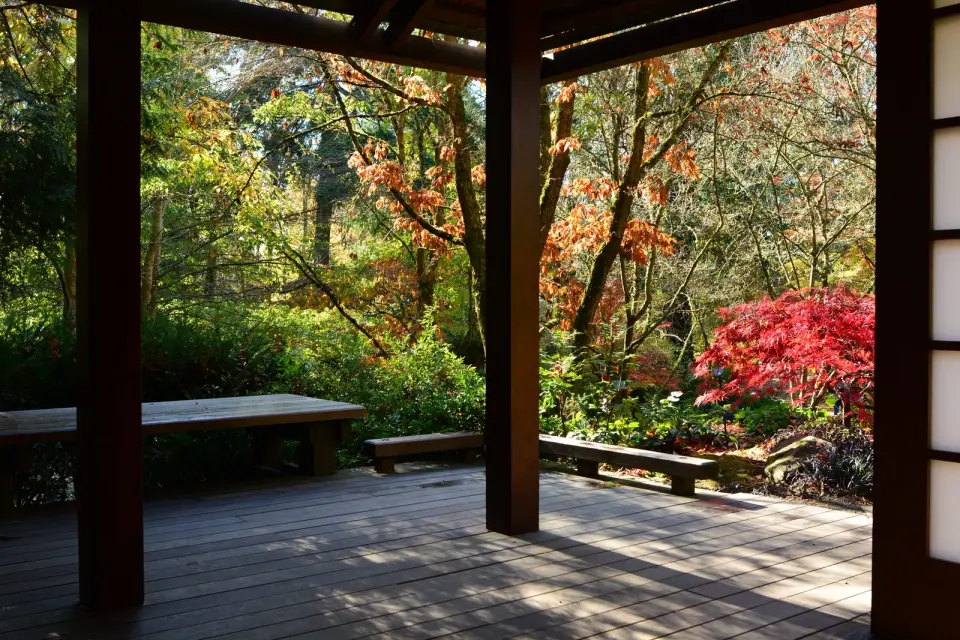
Wander the Rhododendron Glen, where more than 50 kinds of rhododendrons bloom through spring and early summer alongside a fern collection maintained by the Hardy Fern Foundation. Next to it, the Shorts Groundcover Garden follows a re-created mountain stream, and the Tateuchi Pavilion above it gives you a sheltered view over both gardens.
Ravine Experience suspension bridge
Take the side path to the Ravine Experience, a third-mile trail that crosses a 150-foot suspension bridge hanging 40 feet above the forest floor. It opened in 2012 and lets you look down on native understory and tall conifers without stepping on them.
Lost Meadow Trail
Continue onto the Lost Meadow Trail, a one-third-mile loop through ten acres of woodland, meadow and wetland being restored with native plants, where you may spot deer, rabbits and birds. Look for the sculpture Night Blooming, built from wood salvaged from Palouse grain elevators.
More gardens to find
- Rock Garden and Iris Rain Garden: granite outcrops, mountain hemlock and tiny wildflowers set in a landscape modeled on a glacier-carved bowl, with a rain garden fed by a rooftop cistern.
- Waterwise Garden: shady paths showing how to garden with less water and fewer chemicals.
- Native Discovery Garden: layers of Northwest native plants, maintained by the Washington Native Plant Society, with a pond in wetter months.
- Urban Meadow: drifts of grasses and pollinator-friendly perennials near the entrance, with a mason bee exhibit.
- Fuchsia Garden: about 100 hardy fuchsias in a small but colorful space south of the Shorts House.
- Dahlia Display: planted each spring by the Puget Sound Dahlia Association.
What blooms when
- Spring into early summer: rhododendrons in Rhododendron Glen and azaleas in the Yao Garden.
- Summer: hydrangeas in Rhododendron Glen, while the Perennial Border keeps up its color all year.
- High summer through fall: the Dahlia Display, which volunteers lift and store each October.
- Fall: deciduous trees in Rhododendron Glen turn brilliant colors.
- Winter: the fragrant Edgeworthia chrysantha blooms in Rhododendron Glen, and Garden d'Lights takes over at night.
For other gardens in the region, see our Seattle gardens guide.
Garden d'Lights
Garden d'Lights turns the garden into a winter light show of more than half a million lights shaped like plants, flowers, birds, animals and waterfalls. It usually runs nightly from the Saturday after Thanksgiving into early January, closed on Christmas Day, with timed entry tickets sold online only and free entry for children 10 and under.
- Tickets cover a 30-minute entry window, and a few weeknights early in the season are discounted.
- The garden lot charges a per-car fee during the event and often fills, so park free at Wilburton Hill Park or ride Bellevue's free BellHop shuttle.
- Pair it with the Snowflake Lane parade downtown and our holiday lights guide.
In summer, Arts in the Garden usually brings juried artists selling garden art in August.
A little history
Calhoun and Harriet Shorts bought a log cabin and 7.5 acres on Wilburton Hill in 1946, built a modern home in 1957, and spent decades growing gardens around it before leaving the property to the city on the condition that it stay public, according to the garden's history page. The garden opened in June 1992, grew to 53 acres after land purchases in 1989 and 2006, and opened a new visitor center complex designed by Olson Kundig in June 2014.
Getting there from Seattle
By transit: take the Sound Transit 2 Line from downtown Seattle across Lake Washington to Bellevue Downtown Station, beside the Bellevue Transit Center. The garden recommends the RapidRide B Line to NE 8th Street and 124th Avenue NE, then a three-quarter-mile walk with one small incline; Metro Route 220 to 116th Ave SE and SE 1st St is a shorter but uphill half-mile walk. You can also request Bellevue's free, on-demand BellHop shuttle in the Ride Circuit app.
By car: Bellevue is about 9 miles from Seattle across I-90 or the tolled SR 520 bridge. From I-405, take exit 13A to NE 4th Street heading east, turn right on 120th Avenue NE, go south about half a mile to Main Street, turn left, and the entrance is about three blocks up on the right.
The garden also sits on Bellevue's Lake to Lake Trail, so you can walk on to Downtown Park. Plan the rest of your day with our Bellevue guide, Bellevue parks and Bellevue restaurants.