From Downtown to Union Bay
The story begins on Denny's Knoll, a downtown hill where the school opened in 1861 as the Territorial University of Washington. Arthur and Mary Denny gave most of the land, and other pioneer families donated the rest. Those early years were rocky, and low enrollment or lack of money closed the school three times.
By the time Washington became a state in 1889, a growing downtown was crowding the campus. A legislative committee led by graduate Edmond Meany picked a new site at Union Bay, historically Duwamish land. In 1895 the university made the move, settling into the newly built Denny Hall.
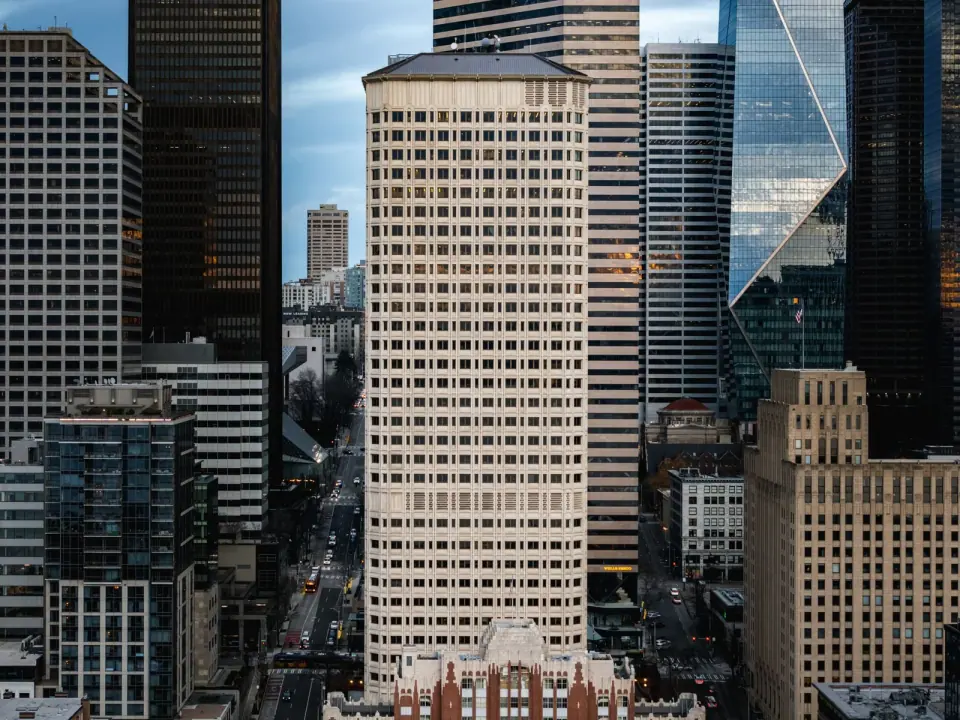
The downtown parcel never sold, so the regents leased it instead. Now known as the Metropolitan Tract, it became one of the university's most valuable holdings. The original building came down in 1908, and a hotel stands on that spot today.
Campus Stops With a Story
The LIFE Columns at Sylvan Grove Theater
Step into the Sylvan Grove Theater to find four white cedar columns, each 24 feet tall and hand fluted in the Ionic style. They are all that survive of the first university building. Meany saved them, and he and a colleague named them Loyalty, Industry, Faith and Efficiency, so the initials spell LIFE.
Drumheller Fountain and the Rainier View
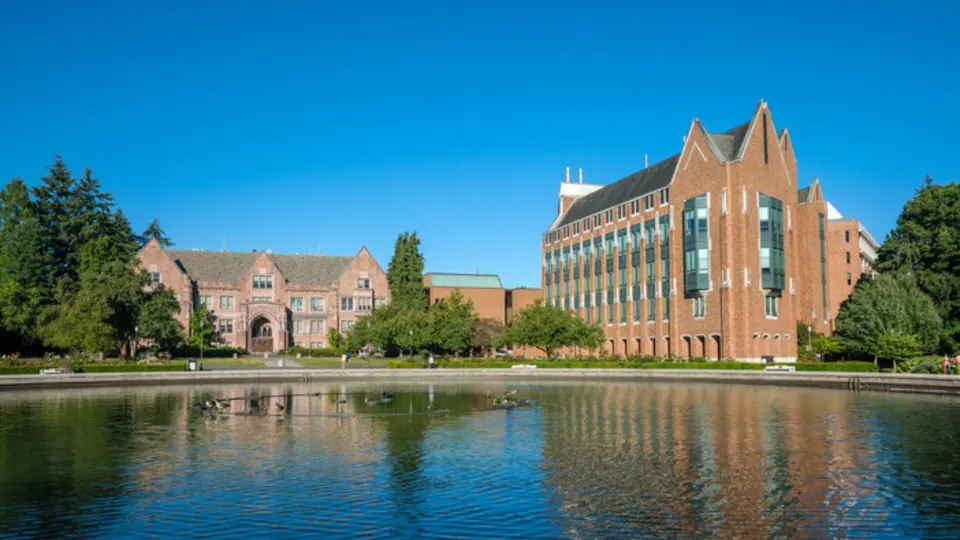
Much of what you walk through traces back to the 1909 Alaska-Yukon-Pacific Exposition. Fair organizers used the largely empty grounds in exchange for handing the site and its development back to the university afterward. They centered the fair on the area around today's Drumheller Fountain, oriented toward Mount Rainier.
John Charles Olmsted helped draw up the site plan, which later folded into the campus master plan, and that is why the grounds still feel so deliberately arranged. Head to the fountain on a clear day and you will see exactly what the planners had in mind.
Suzzallo Library and the Quad
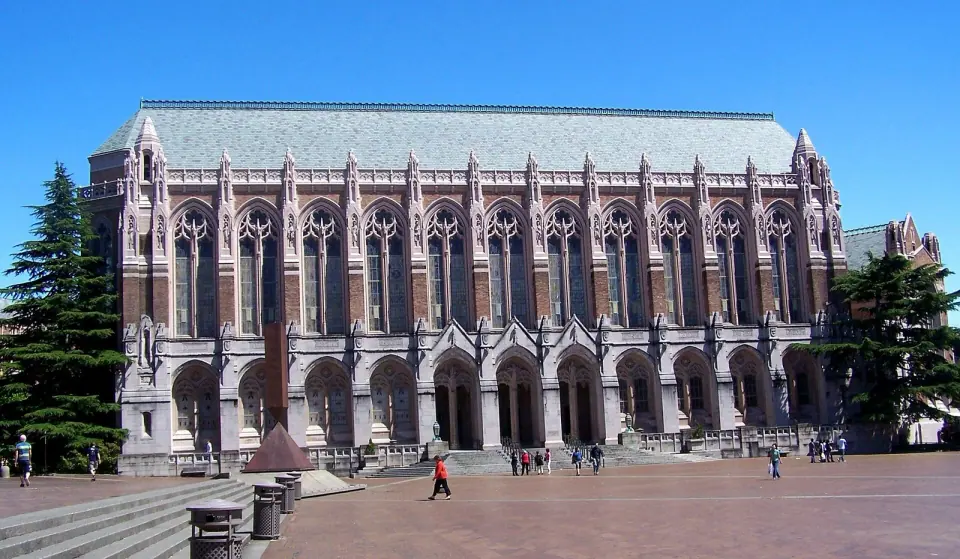
Make time for Suzzallo Library, considered the architectural centerpiece of campus, built in 1926 and expanded in 1935. Then stroll over to the Liberal Arts Quadrangle, simply the Quad to students, which took shape between 1916 and 1939 during a major expansion of upper campus.
Buildings on the City Landmark List
Keep an eye out for structures listed in City of Seattle landmark records, including Anderson Hall, Parrington Hall, Eagleson Hall, the Faculty Club and the Engineering Annex, also listed as the AYPE Foundry in a nod to the 1909 fair. Down by the water, the old Canoe House, once the ASUW Shell House and a US Naval Training Hangar, is protected too.
The Montlake Bridge and Montlake Cut, at the southern edge of the area, share the same list. Browse Seattle's designated landmarks to see just how many protected sites cluster around the university.
A Campus That Shaped Seattle
The university's influence reaches well beyond its buildings. A medical school formally opened in 1946, laying the groundwork for the UW Medical Center, which U.S. News and World Report has ranked among the nation's top ten hospitals. Today UW is known for medical, engineering and scientific research and belongs to the Association of American Universities.
Research spending reached $1.73 billion in 2024, fifth highest in the country according to the National Science Foundation. Between 1958 and 1973, as baby boomers arrived, enrollment more than doubled to 34,000. If you follow sports, you know the 22 varsity teams as the Huskies, who compete in the Big Ten Conference.
Some chapters are sobering. In 1942, people of Japanese ancestry in the Seattle area were forced into inland camps, and President Lee Paul Sieg worked to help Japanese American students transfer away from the coast, though many could not leave in time. Those students were finally honored at the Long Journey Home ceremony in May 2008.
Exploring the University District
Saturday Farmers Market
Walk a short way west of campus to the University District Farmers Market, which runs every Saturday year round at NE 52nd St and University Way NE. Opened in 1993, it is one of Seattle's earliest neighborhood markets. Hours are listed as 9 am to 2 pm, but confirm before you go since schedules can change.
Libraries and Historic Streets
Head to Roosevelt Way NE in University Heights for the University Branch, one of The Seattle Public Library's oldest branches. Its building, the University Library landmark, earned city landmark status in 2003. Several other protected buildings stand within easy walking distance, making this a natural add-on to your campus visit.
Parks and Community Gardens
For a quieter break, find University Playground, a city park on 9th Ave NE close to the branch library. The neighborhood also has several City of Seattle P-Patch community gardens, including University Heights and the University District P-Patch, which dates to 1976.