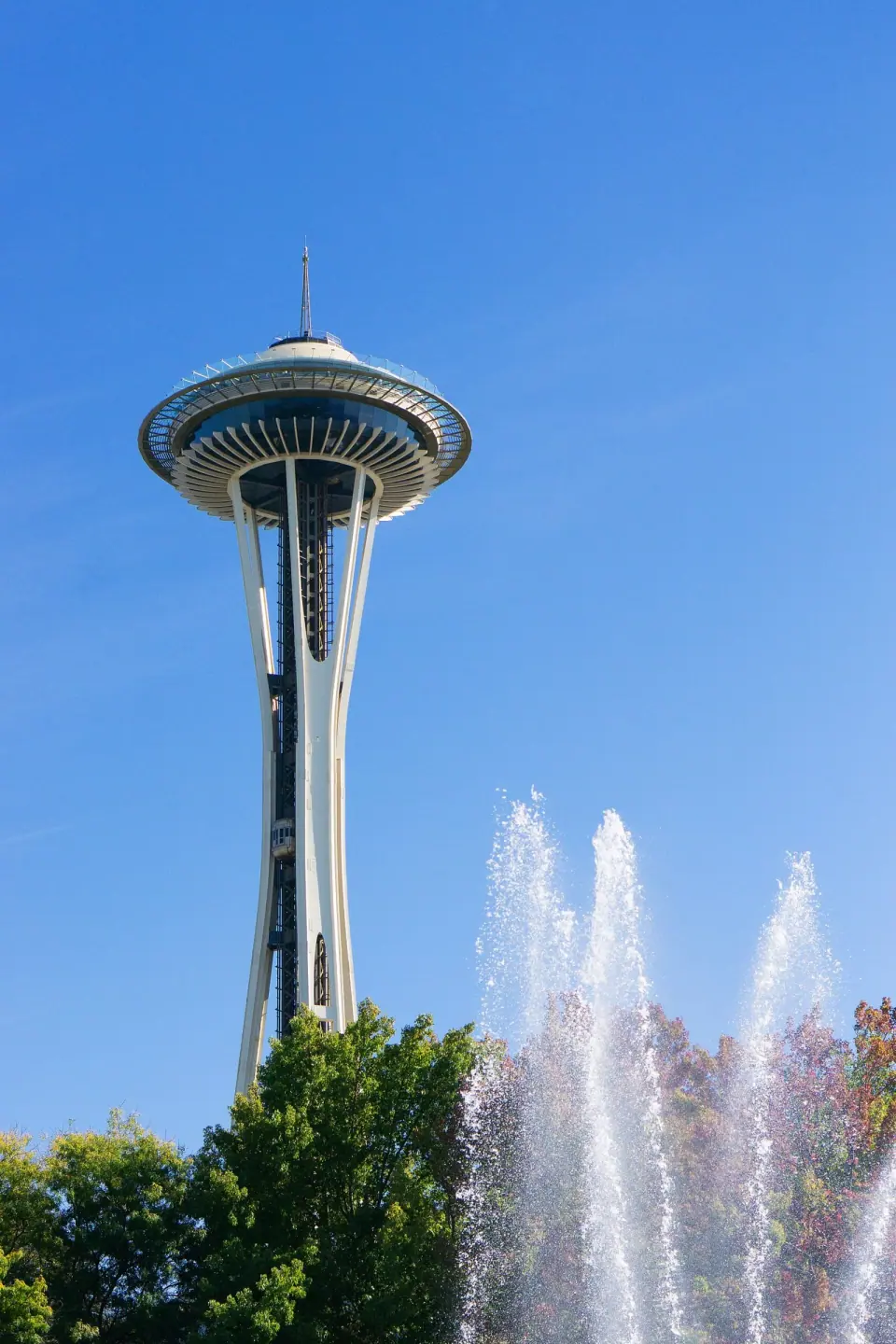
Pause at the entrance fountains, which have their own claim to fame as a backdrop in the Elvis Presley film It Happened at the World's Fair. Fans of midcentury Seattle can stand in that very courtyard today.
Yamasaki's Famous Arches
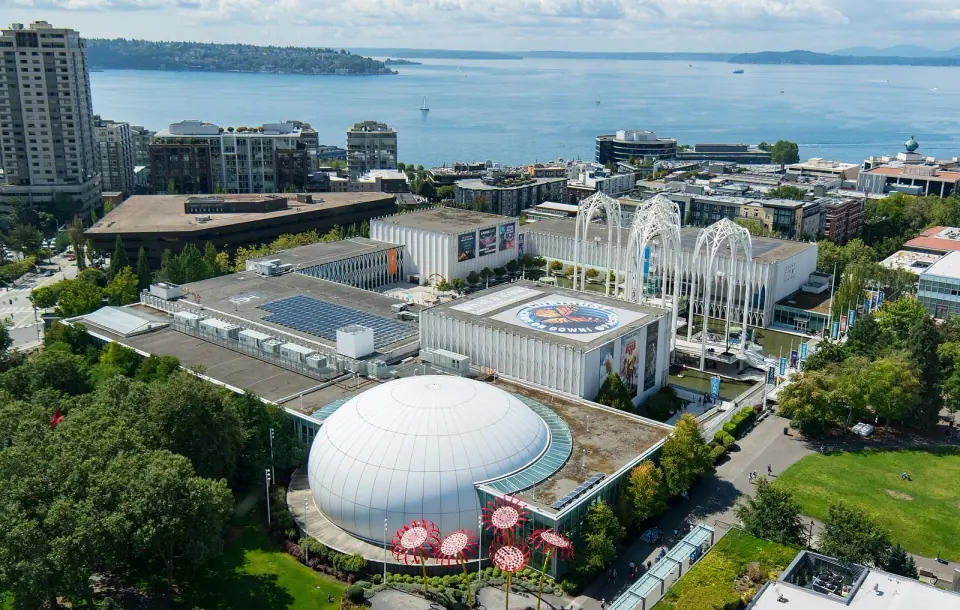
Look up at the design that earned Minoru Yamasaki international recognition and a place on the cover of Time magazine. He went on to design the World Trade Center in New York City, and the arch shapes you see here became a recurring motif in his later work.
Walk along any of the buildings and you will notice the walls are made from many pre-cast concrete slabs that join to form the pointed arches. The complex covers 7.1 acres, and its courtyard pools and arches remain one of the most photographed corners of Seattle Center. Plans announced in 2025 call for renovating the courtyard, tying it more closely to the rest of the Seattle Center grounds and improving public access.
Sonic Bloom
Just outside, five flower sculptures about 33 feet tall rise near the museum. Seattle artist Dan Corson created Sonic Bloom after the center issued a 2013 call for public art that showed off solar energy, and he drew on the Australian firewheel tree for the design. Solar panels in the flower heads generate electricity, so the flowers hum as you walk up and glow once darkness falls.
What Fills the Eight Buildings
Today Pacific Science Center spreads across eight buildings, so give yourself room to wander. Highlights include:
- Two IMAX theaters, a rare setup that few places in the world can match
- The Seattle Laser Dome, one of the largest laser theaters in the world, home to laser light shows
- A planetarium
- A tropical butterfly house
- A dinosaur exhibit, first installed in 1990
- Hundreds of hands-on science exhibits, plus rotating traveling and temporary shows
IMAX and the Laser Dome
Catch a film where Pacific Science Center's first IMAX screen opened in 1979, converted from the Eames theater. That room was originally built to show a multi-screen IBM film during the World's Fair. The Laser Dome has a backstory of its own, starting life as the Spacerium, a domed theater built for a wide-angle film voyage through space.
Pieces Left From 1962
Only a few original fair exhibits survive, so keep an eye out for the Lens and Mirror Machine and a suspended model of the moon, both carried over from the exposition. The fair's famous illusion ramp, where buildings were deliberately constructed at a tilt, was recreated in the late 1990s.
Decades of Live Demonstrations
Live science runs deep here. Dixy Lee Ray directed the center for many years before she became governor of Washington, and she also hosted a science program for schoolchildren on Seattle PBS station KCTS-9, which helped build the center's audience among young viewers.
In the 1970s, guides in orange jackets, nicknamed "OJs," ran demonstrations throughout the museum. The math floor featured a large exhibit originally built for IBM at the New York World's Fair, including a probability machine that sounded an alarm before releasing a bin of balls, and it stayed until around 1980. Other buildings held a full-size lunar module mockup, a replica First Nations longhouse and a working hydraulic model of Puget Sound.
The 1980s brought rapid growth under executive director George Moynihan, hired in 1980 from Berkeley's Lawrence Hall of Science. A 1984 exhibit, China: 7000 Years of Discovery, raised the center's national profile. Traveling robotic dinosaur shows later in the decade paved the way for the permanent dinosaur display, while Kids Works, Body Works, an animal area and a tide pool opened in the same era.
Programs Beyond the Museum Floor
Pacific Science Center keeps busy year round with programs for every age. Look for youth and teen programs, summer camps at locations around Puget Sound, science-themed events for adults 21 and over, and research weekends.
The Science On Wheels vans bring hands-on lessons to schools across the Pacific Northwest, and a dedicated staff team supports teachers. In Bellevue, the center partners with the City of Bellevue on the Mercer Slough Environmental Education Center, which teaches wetland ecology, nature awareness and environmental stewardship.
Ownership is also shifting: in 2026, part of the museum was sold to Center Art LLC, a company associated with the owners of the Space Needle.
A City Landmark Since 2010
The Seattle Landmarks Preservation Board recognizes Pacific Science Center as City of Seattle landmark number 347. The 2010 designation, made under ordinance 124932, protects one of the most distinctive pieces of the 1962 fair, and the building joins a cluster of other designated sites on the Seattle Center grounds. Browse the full list of Seattle landmarks to plan more stops.
Planning Your Visit
Head to 202 2nd Ave N, at the southwest corner of the Seattle Center campus. Ticket prices, current hours, show schedules and parking details change, so check the museum's official website before you go.
Leave time for both the exhibit halls and a screening, since the IMAX theaters, Laser Dome and planetarium each run their own programs. Then linger in the courtyard after dark, when the Sonic Bloom flowers light up.