Distance, terrain and timing
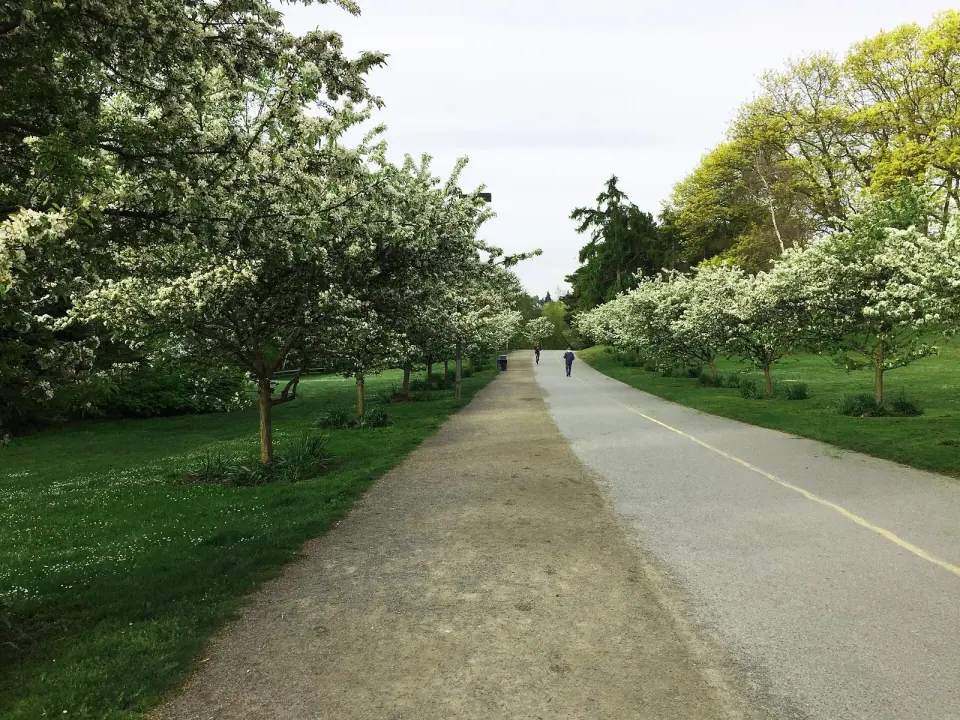
The paved loop runs 2.8 miles and changes elevation by only a few feet, which makes it an easy pick for kids, strollers and anyone easing back into exercise. Wheelchair users may want to keep in mind that some stretches have a slight cross slope.
Want a longer outing? Follow the unpaved outer path, which runs about 3.2 miles along the edge of the park. Pairing a lap of each gives runners a bit more variety without ever leaving the neighborhood.
Know Your Lane
The path is divided so different users can move along without colliding. Seattle Parks and Recreation posts guidelines, and following them keeps the loop pleasant for everyone.
- Walkers and runners stay in the inside lane, the one closer to the water, traveling no more than two side by side.
- Wheeled users head to the outside lane, moving one way in the direction of the painted arrows, single file, at no more than 10 miles per hour.
- Motorized devices, gas or electric, are not allowed, except for motorized wheelchairs.
- Dogs must be leashed, on leashes no longer than 5 feet.
- Everyone should slow down where the path gets congested.
Rules for bikes, skates and scooters have shifted in recent years. During the COVID-19 pandemic, the parks department barred wheeled vehicles from the paved path because of heavy foot traffic and the new protected bike lanes on Green Lake Way, and that restriction was classified as a long-term temporary measure. Before bringing wheels, check the official Green Lake Park page from Seattle Parks and Recreation.
Sights Along the Way
One lap carries you past swimming beaches, playfields and boat docks, along with traces of some colorful chapters of Seattle history. These are the stops worth slowing down for.
Duck Island and Prospect Point
Look out to the small island in the lake, which is entirely artificial. The Works Progress Administration built it from dumped gravel in 1936 as a wildlife sanctuary, first naming it Swan Island. Nearby, Prospect Point reaches toward the island like a pointing finger, sheltering a patch of water from strong winds.
Remnants of the Aqua Theater
Keep an eye out for what remains of the Green Lake Aqua Theater, built by the city in 1950 for the first Seafair. Its grandstand held more than 5,000 people for the Aqua Follies, a blend of water ballet, dance and comedy. After years of decline, a 1969 Grateful Dead concert revealed how unsafe the grandstand had become, and dismantling began in 1970. Today you can walk out on part of the old stage, now a pedestrian pier, and some grandstand sections still stand.
The Bathhouse and the lantern memorial
On the west side, the 1927 bathhouse now houses Seattle Public Theater, a small stage for plays. Just south you will find a lawn and fishing pier, where a yearly floating lantern memorial has honored victims of the Hiroshima and Nagasaki bombings, and of all wars, since 1984.
The northeast shore
Across the lake stands the community center, built in 1929 on pilings because it rests on land created when the lake was lowered. Next door is Evans Pool, added in 1955 and named for brothers Ben and Lou Evans, who served Seattle parks athletics for many years; it is now a City of Seattle landmark. The city has been gathering public input on future plans for the community center, pool and play area.
Just east of the park, stop by the Green Lake Library, which opened in 1910 with Andrew Carnegie funding and became a city landmark in 2003. It makes an easy detour before or after your lap.
Swim, Paddle and Spot Wildlife
Cool off at one of two lifeguarded beaches. West Green Lake Beach sits near the Seattle Public Theater building, while East Green Lake Beach lies near the community center and Evans Pool. Lifeguard seasons change each year, so check the city's swimming beach schedule before you plan a swim.
Before wading in, know that the lake has a long history of algae blooms, and milfoil and swimmer's itch, caused by parasites from waterfowl, remain concerns. No natural streams flow in or out, so the lake depends on rain, storm runoff and city water.
Paddling the lake
Glide across quiet water on a canoe, rowboat, pedal boat or sailboard. Motorized boats have been banned from public use since at least 1968, though hydroplanes once raced here from 1929 to 1984. Carry your boat by hand to the water at the shoreline access points at the east end, the cove and northwest of Duck Island.
On the south end, the Green Lake Small Craft Center, a parks facility, is home to Green Lake Crew and the Seattle Canoe and Kayak Club. Its floats are reserved first for city programs.
Birds and trees
Hundreds of species of trees and plants grow in the park, which also shelters many birds. Watch for American coots, ducks and geese near the shore, beneath Douglas fir, Western red cedar, alder and madrona along the water. Mind your step, since goose droppings dot the path, especially near the grass.
A Glacial Lake, Reshaped
As you walk, picture how much older the lake is than the park around it. The city says the Vashon glacial ice sheet formed it about 50,000 years ago, and dredging has turned up volcanic ash from a Glacier Peak eruption roughly 6,700 years ago. In Lushootseed, the lake is called dxʷƛ̕əš.
Surveyor David Phillips gave it its English name in 1855, inspired by its greenish tint from algae. The state handed the lake to Seattle in 1905, and it joined the Olmsted Brothers' parks plan. In the years that followed it was diked, dredged and filled, shrinking by nearly 100 acres; the water dropped 7 feet in 1911, and fill from building Aurora Avenue later extended the southwest shore.