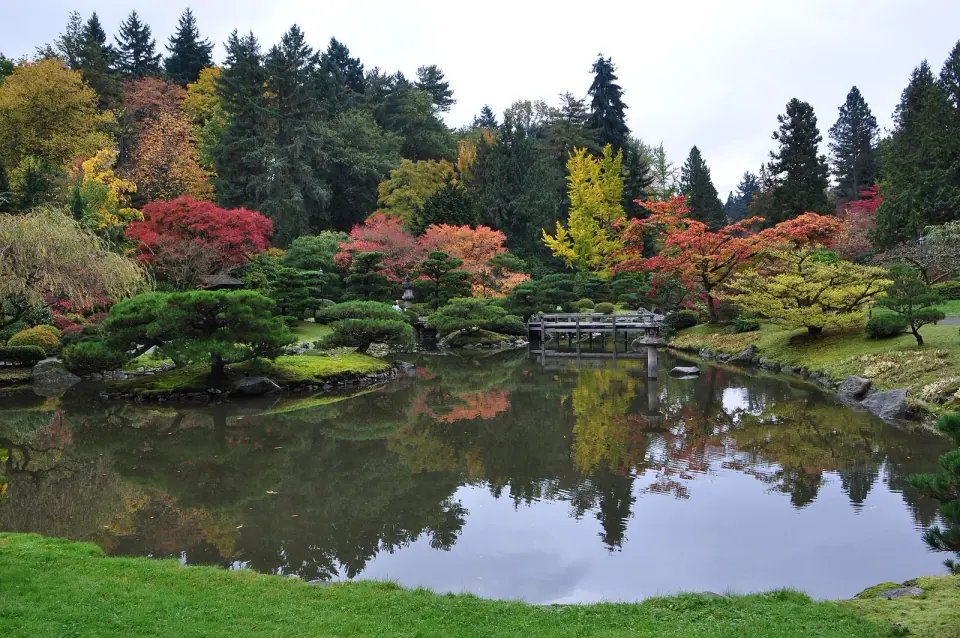
Time it well, because the garden closes for winter maintenance from December through February. If you want color, aim for May, when most of the rhododendrons and azaleas burst into flower, or for autumn, when the Japanese maples turn red, orange, yellow, purple and pink. Summer brings long evenings and the garden's later closing times.
Seasonal highlights
- Spring: the garden reopens in March, and flowering trees, including the cherry planted by Japan's Crown Prince and Princess in 1960, wake up the paths.
- May: peak bloom for the garden's azaleas and rhododendrons.
- Summer: the longest opening hours of the year and the season's public tea presentations in the Shoseian teahouse.
- Autumn: maple color and the Momijigari maple viewing celebration; the garden's season ends in November.
Tea ceremony at Shoseian
Book a seat at a 40-minute tea presentation in the Shoseian teahouse, set in a traditional roji garden. Presentations run from April through October and are hosted by three local tea schools, the Chado Urasenke Tankokai Seattle Association, Omotesenke-ryu and Chaboshu. Reservations are required and the tea ticket is separate from garden admission; guests are encouraged to sit on tatami mats, and bench seating is available if you need it.
Plan your visit
- Hours vary by season: the garden is open Tuesday through Sunday from March through November, with closing times that run later in summer and earlier in spring and fall, and it occasionally opens at noon. Final entry is 45 minutes before closing, so check the location and hours page for the month you visit.
- Admission: children 5 and under enter free, and youth, seniors, students, military and adaptive visitors pay a discounted rate. Buy tickets at the ticket booth, and check current prices on the official site. Seattle Public Library cardholders can also reserve a free Museum Pass for the garden.
- Free guided tours: volunteer guides lead tours from April through October, Tuesday through Saturday at 11 am, limited to the first 10 visitors, and there is a 1 pm tour on Free First Thursday.
- Getting there: the free parking lot is small and often busy on weekends, and Metro route 11 stops nearby on Madison Street.
- Garden etiquette: stay on the paths and off the moss, do not feed the koi or turtles, and leave food at home, since only water is allowed and picnics are not. Pets are not allowed, though service animals are welcome.
- Accessibility: wheelchairs are welcome on the mostly level gravel and paved paths, though a few sections are not accessible.
Planned in Tokyo, Built With Washington Stone
As you wander the paths, you are following a plan drawn up by six landscape architects and designers chosen by the Tokyo Metropolitan Government. Kiyoshi Inoshita and Juki Iida led the team, which presented its plans for Seattle in 1958.
Iida hired Japanese American contractors because they understood the Japanese language and its design traditions. William Yorozu handled the plants, Richard Yamasaki set the stones and Kei Ishimitsu built the garden structures you see today.
Look closely at the rocks, because most of the materials came from close to home. On a trip to the Snoqualmie Pass area, Iida picked out 600 short tons of granite boulders from Bandera Mountain, ranging from 1,000 pounds to 11 tons, and each one traveled to Seattle wrapped in bamboo matting.
What you will see growing
The boulders were placed to set off plantings chosen to suit a Japanese garden. Planting began in March 1960, and you can browse:
- Azaleas
- Rhododendrons
- Camellias
- Mosses
- Ferns
Members of the public also donated about 100 flowering trees, most of them gifts from Japanese American associations.
How the Garden Came to Be
Seattle's interest in a Japanese garden reaches back to the 1909 Alaska Yukon Pacific Exposition, a world's fair that featured a temporary Japanese Pavilion with its own garden.
By 1937 the new Washington Park Arboretum had been proposed as the home for a permanent garden, but racial tensions and the start of World War II stalled the idea for two decades.
Looking ahead to the 1962 World's Fair, the Arboretum Foundation began raising money in 1957 and worked with Japanese diplomats in Seattle to find donors and designs. Fujitaro Kubota, a local gardener and landscaper, supplied the first cost estimates. Construction started in late 1959, and Mayor Gordon S. Clinton dedicated the garden on June 5, 1960.
A royal visit and a symbolic birch
In October 1960, Japan's Crown Prince Akihito and Crown Princess Michiko stopped in Seattle to tour the new garden, planting a cherry tree and a white birch together. The birch is the o-shirushi, or symbol, of the Princess's family.
Entry was free at first, until turnstiles went in with a 10-cent fee in May 1961.
Shoseian, the Teahouse
The teahouse you find here has lived two lives. The original, a gift from the Tokyo government, arrived in Seattle in pieces in March 1959, went on temporary display at a trade fair the next month, and began taking shape in its permanent setting on May 19 of that year.
Urasenke grand master Sen Sōshitsu XV performed the first tea ceremony there on July 4, 1959.
Vandals burned the teahouse on April 9, 1973. Over eight years, the Arboretum Foundation raised $175,000 with help from the Urasenke Foundation, and Yasunori "Fred" Sugita rebuilt the structure in 1980 and 1981.
Sen Sōshitsu XV returned on May 16, 1981 to rededicate the teahouse, which was given the name Shoseian.
How the Garden Has Changed
Over the decades the garden has been refreshed several times while keeping its original design intent:
- Late 1990s: several paths were reworked to meet wheelchair accessibility requirements.
- 2001 to 2002: a major renovation restored the eroded pond and replaced worn bridges and plants.
- 2008: the Seattle Landmarks Preservation Board named the garden a city historical landmark on May 21, and it is listed as City Landmark No. 317.
- 2009: a new gatehouse opened, with a bronze gate by Seattle sculptor Gerard Tsutakawa.
The garden also added a community meeting room. On December 1, 2020, it received the Japanese Foreign Minister's Commendation for promoting mutual understanding between Japan and the United States.
Festivals Through the Seasons
Time your visit for one of the garden's cultural celebrations, which run across the calendar. Recurring events include:
- Kodomo no Hi (Children's Day)
- Tanabata
- Wondering and Wandering
- Otsukimi (Moon Viewing)
- Keiro no Hi (Respect for Elders Day)
- Momijigari (Maple Viewing)
Catch local calligraphers, taiko ensembles, dance troupes and traditional musicians at these events. Before you go, check the garden's official website for this year's dates, hours and admission.
Explore the Arboretum's South End
Because the garden sits inside the larger Washington Park Arboretum, it is easy to stretch your visit into a stroll through the arboretum's grounds. Washington Park Playfield is less than 0.1 mile away.
Other spots within a short walk include:
- 3001 E Madison, a small park about 0.2 mile away
- Madison Valley Mad P and Ida Mia Garden, two community gardens about 0.2 mile away
- Prentis I. Frazier Park, about 0.4 mile away
- Boyer/Lambert House, a city landmark about 0.5 mile away
- Pelican Tea Garden, a community garden about 0.6 mile away
To see more of the surrounding area, head to our guide to the Stevens neighborhood.