True Northwest: The Seattle Journey
Ringing most of the second floor, MOHAI's core exhibit walks you through the region's story in 22 sections, from the era before pioneer settlement up to the modern day. Look for the Petticoat Flag, a US flag sewn by women during the 1856 Battle of Seattle, among the keynote objects.
Maritime Seattle
Climb to the top floor for the maritime gallery, a room first built as a replica ship's bridge to train naval recruits during World War II. The star is a working World War II-era submarine periscope that gives you a 360-degree view of Lake Union and downtown.
Bezos Center for Innovation and Kid-Struction Zone
The Bezos Center for Innovation, which opened in 2013 in part of the Grand Atrium, adds a newer gallery to the museum, and families with young children can head for the Kid-Struction Zone, designed for kids aged 2 to 7 and their caregivers, with giant foam bricks, a magnetic ball-and-pipe board and a reading corner. MOHAI also rotates temporary exhibits through its Walker Gallery, so check the MOHAI visit page for what is on now.
Free First Thursdays and Other Ways to Save
MOHAI offers free admission on the first Thursday of every month from 5 to 8 p.m. to its permanent exhibits, including True Northwest, Maritime Seattle, the Kid-Struction Zone and the Bezos Center for Innovation. Special exhibits are not included during those free hours.
- Library museum pass: Seattle Public Library and King County Library System card holders can reserve a pass for two free adult admissions, per MOHAI's community access page. Our library museum pass guide explains how to book.
- Kids: youth 14 and under get in free, but they must be accompanied by an adult.
- Caregivers: caregivers assisting visitors with disabilities are admitted free.
- Re-entry: tickets are good for the whole day, with re-entry using your receipt.
For more ways to see Seattle's museums for less, read our guide to free museums in Seattle.
Hours
MOHAI is typically open five days a week, Thursday through Monday, from 10 a.m. to 5 p.m., and closed on Tuesdays and Wednesdays, with closures on some holidays. Hours can change, so confirm on the official visit page before you go.
Getting There and Parking
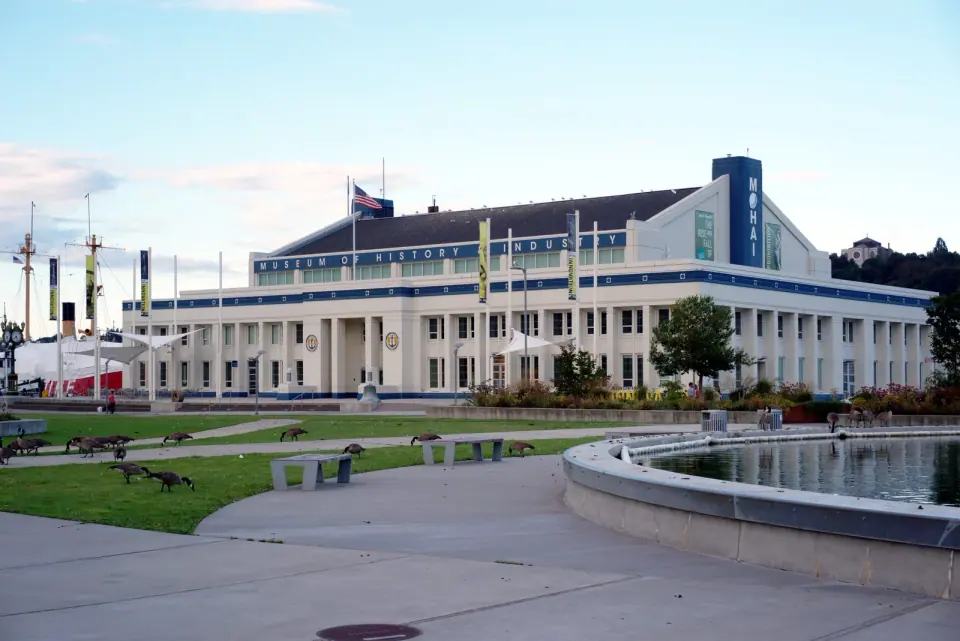
MOHAI sits at the south end of Lake Union, in the park at Valley Street and Terry Avenue N, with its accessible entrance on the west side of the building.
- Streetcar: the South Lake Union Streetcar stops by the park, about a block from the museum; see our Seattle Streetcar guide. Several King County Metro bus routes also serve the area.
- Driving: from I-5 or State Route 99, use the Mercer Street exit. The lot next to the museum is for ADA parking and drop-off only, reached by a callbox at the gate near the Center for Wooden Boats.
- Public parking: the closest public lot is at the south end of the park at Valley Street and Terry Avenue N.
- By bike: bike racks are by the building.
A Short History of MOHAI
The museum grew out of the Seattle Historical Society, founded in 1914 after Morgan and Emily Carkeek's Founder's Day gatherings, and opened its first museum in Montlake in 1952. When the rebuilding of State Route 520 forced a move, MOHAI restored the Naval Reserve Armory on Lake Union in a $90 million campaign and opened its new home on December 29, 2012. Today it is the largest private heritage organization in Washington, with a collection of nearly four million artifacts, photographs and archival items, and it is a Smithsonian affiliate.